
A Tale Of Two Trailblazers
This article was originally published by MSM and is republished here with permission.
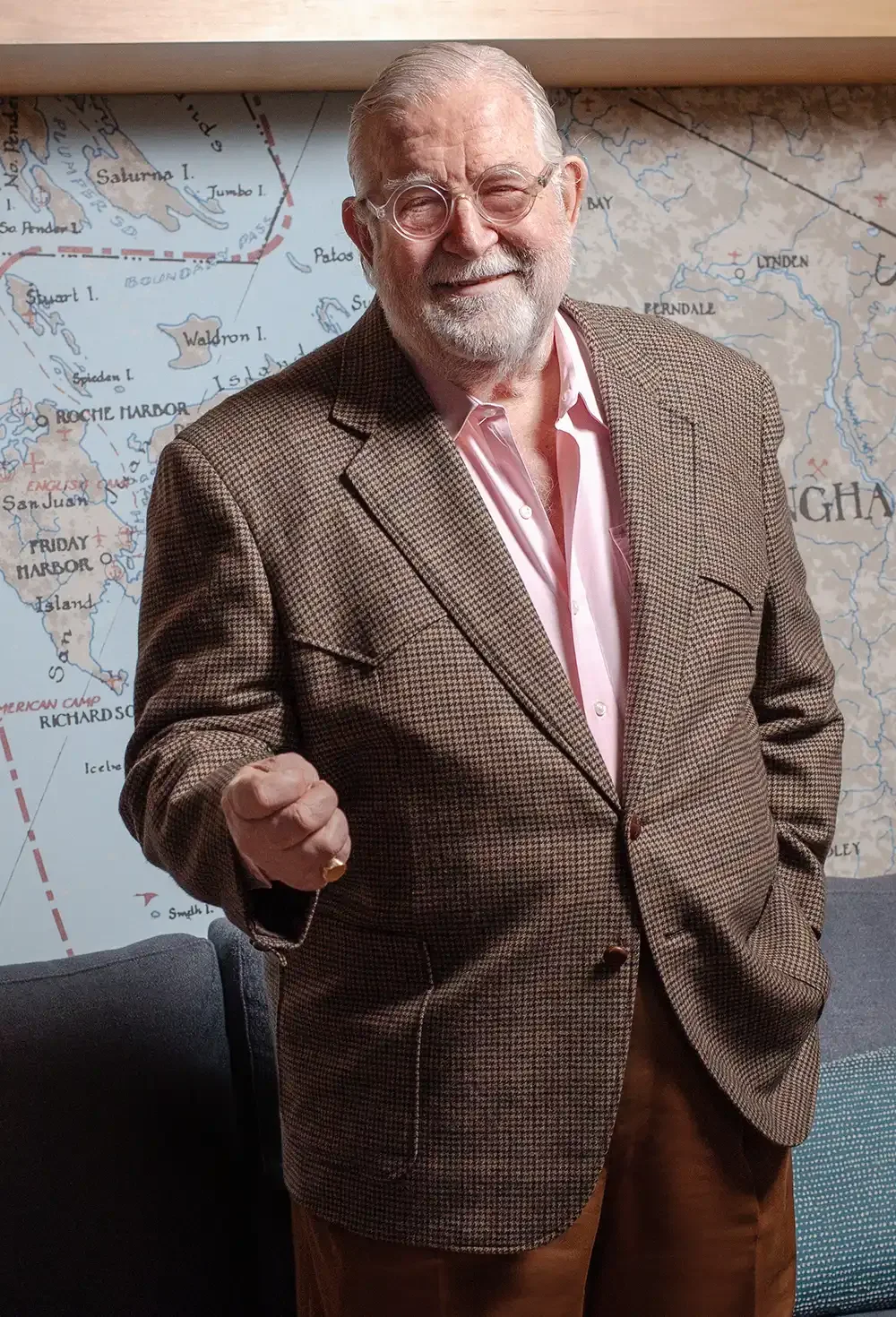
Hardy Good

Helen Ng
A Tale Of Two Trailblazers
Launching Self Storage In Hong Kong
Known as a vertical city, where land is scarce and the only way to go is up, Hong Kong holds millions of untold stories. Hardy Good and Helen Ng may be just two of them, but their impact has reshaped the commercial real estate sector and the way Hongkongers live. Good is the American pioneer who helped launch Hong Kong’s self-storage industry; Ng is the Asian trailblazer who broke barriers to build a successful, female-led enterprise.
“She’s a powerhouse,” Good says of Ng when her name comes up. Ng is equally complimentary when his name is mentioned in a separate interview. “Hardy was an original, and he saw an opportunity that others missed.”
Though their paths occasionally crossed in the early days—after all, they were both starting businesses in an industry that was just getting started itself—each has a unique story set within “The Pearl of the Orient.”
Good Goes East
Good began his career as a menswear buyer and merchandiser in Ohio, but a series of unexpected turns brought him into the emerging U.S. self-storage industry, where he is now considered one of its founding fathers. He formed MiniCo in 1974, and it quickly became a broad-canopied enterprise, with branches stretching into facility development, insurance, publishing, and product distribution. One of those products was padlocks manufactured in mainland China. On each trip, he flew through Hong Kong and noticed a glaring gap. “There was a marketplace of seven million people and no self-storage,” he says. “I thought we could be very successful there, so we did market research for over a year to confirm my suspicion.
The findings were favorable, and MiniCo went to work establishing MiniCo Asia, Ltd. But progress was slow, with short-term leases making it difficult to secure property. “Without a long-term option, we felt it was better to own,” Good says. “We searched for over a year, and everything suitable wasn’t affordable, and vice versa.”
After 18 months, Good was ready to abandon the project. Then came a turning point. “On the very last day, on the very last Realtor tour, we came to a dead stop in traffic. I looked up out the window at this building and said, ‘Well, what about that place?’”
It was the Crocodile Building, a landmark on the Hong Kong horizon. Nothing was for sale, but they negotiated a two-year lease with an option to renew. “We decided we could work with that, testing the idea by renting since we couldn’t buy anyhow.”
MiniCo Asia leased one floor, filled it within a year, then leased another and another. Eventually, the company occupied 50,000 square feet before the building was sold and torn down. “Knowing we had to move, we got serious, bought our first owned facility on Hong Kong Island, and expanded from there,” Good says with a grin. “It took some courage, ignorance, and a few million dollars.”
Within two years, copycats flooded the market, but MiniCo Asia remained on top, even taking home GoHome real estate’s “Best Storage award” in 2013. On the heels of that win, the company was approached by global investment firm Blackstone. “They told us they wanted to be Asia’s dominant self-storage operator, and they wanted us because we were leading the way.” It was a tough, year-long negotiation, and Good credits Hong Kong COO Marilyn Leslie for seeing it through, along with the late Ched Yu, who served as the company’s “guide, advisor, and friend.”
“There was a marketplace of seven million people and no self-storage. I thought we could be very successful there, so we did market research for over a year to confirm my suspicion.”
When Good sold MiniCo and MiniCo Asia, he kept the corporate entity (changing the name to New Empire Ventures and becoming its sole shareholder and chairman), but everything else went with it: properties, goodwill, logo, and name. “And let me tell you,” Good says, wagging a finger, “that name had a lot of goodwill in Hong Kong. In Chinese, it’s Mei Lei Cheong … you’ll have to get Helen to tell you the full translation.”
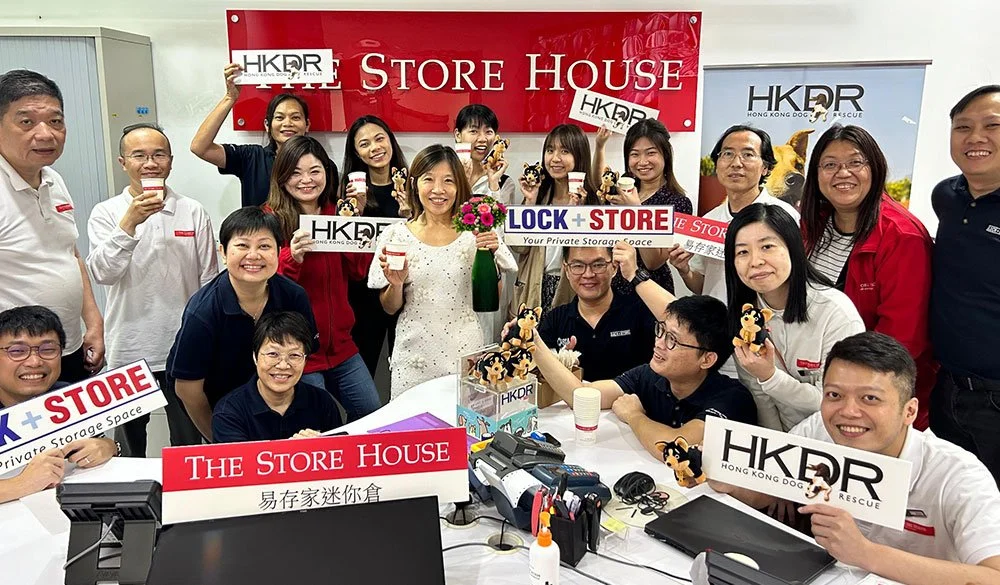
Helen Ng and The Store House support the Hong Kong Dog Rescue
Ng In The House
Ng smiles when asked. “Mei (美) means beautiful, Lei (利) means convenience, and Cheong (倉) means warehouse. It’s the perfect name for a self-storage company.”
As the eldest daughter of a taxi driver and a homemaker, Ng collected beer bottles for pocket money, but never considered herself disadvantaged until a professor told her to “buck up” because she was in the bottom five percent of Singapore’s socioeconomic strata.
“I told myself I’d prove him wrong,” she says.
She did. Today, Ng is chairwoman of the Self Storage Association Asia and Singapore’s first female self-storage CEO at General Storage Company, which operates Lock+Store in Singapore and Malaysia and The Store House in Hong Kong. The latter was incorporated in 1999, opening its first site in 2002. “We were among the originals with Hong Kong Storage and SC Storage. Then came StoreFriendly, Apple, Cube, and more recently Redbox,” says Ng, adding that self-storage in Hong Kong began with individuals familiar with the industry, like Good, or those who discovered it overseas, like SC Storage’s Kevin Shee, who imported the concept from Canada. And although penetration is under one percent, Hong Kong remains one of Asia’s more mature markets after Japan.
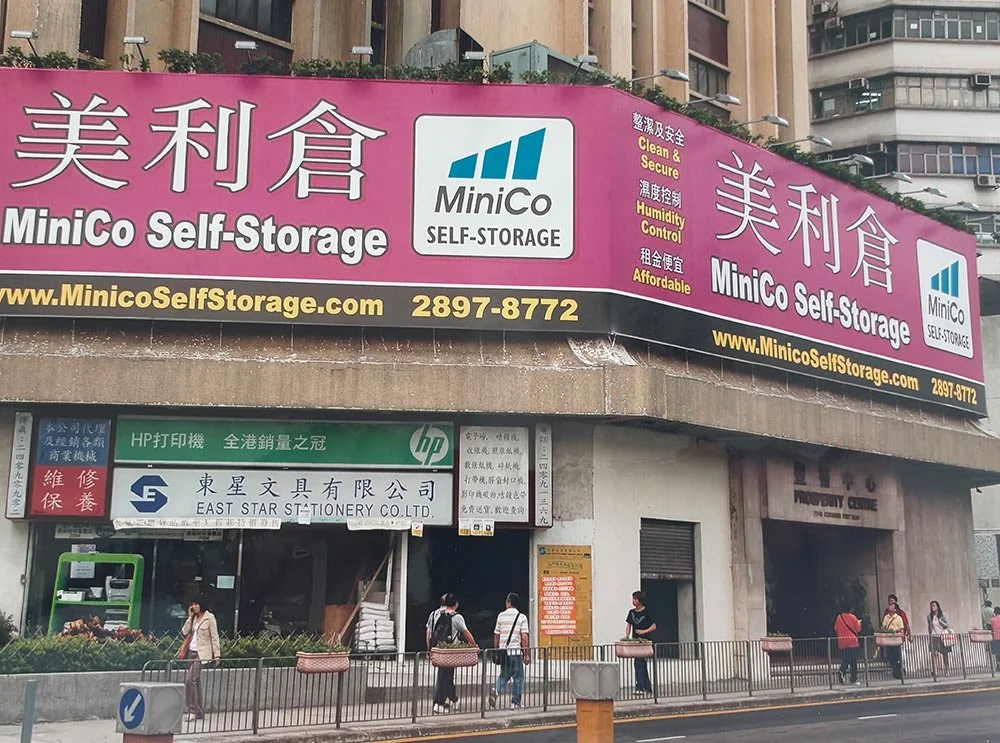
Exterior of MiniCo Self-Storage building
Roughly 20 percent of The Store House’s customers are businesses, mostly small enterprises with offices barely large enough for a desk and chair. The rest are residential users driven by extreme population density and micro-apartments. Typical living space for a middle-income household with two adults is under 400 square feet, around 500 with children. “I’d been to colleagues’ apartments and would see platforms built to hold storage beneath the living space or overhead, anywhere they could put it,” says Ng. “Now, everyone I know in Hong Kong has a unit or even two. It’s an extension of their living space.”
“Now, everyone I know in Hong Kong has a unit or even two. It’s an extension of their living space.”
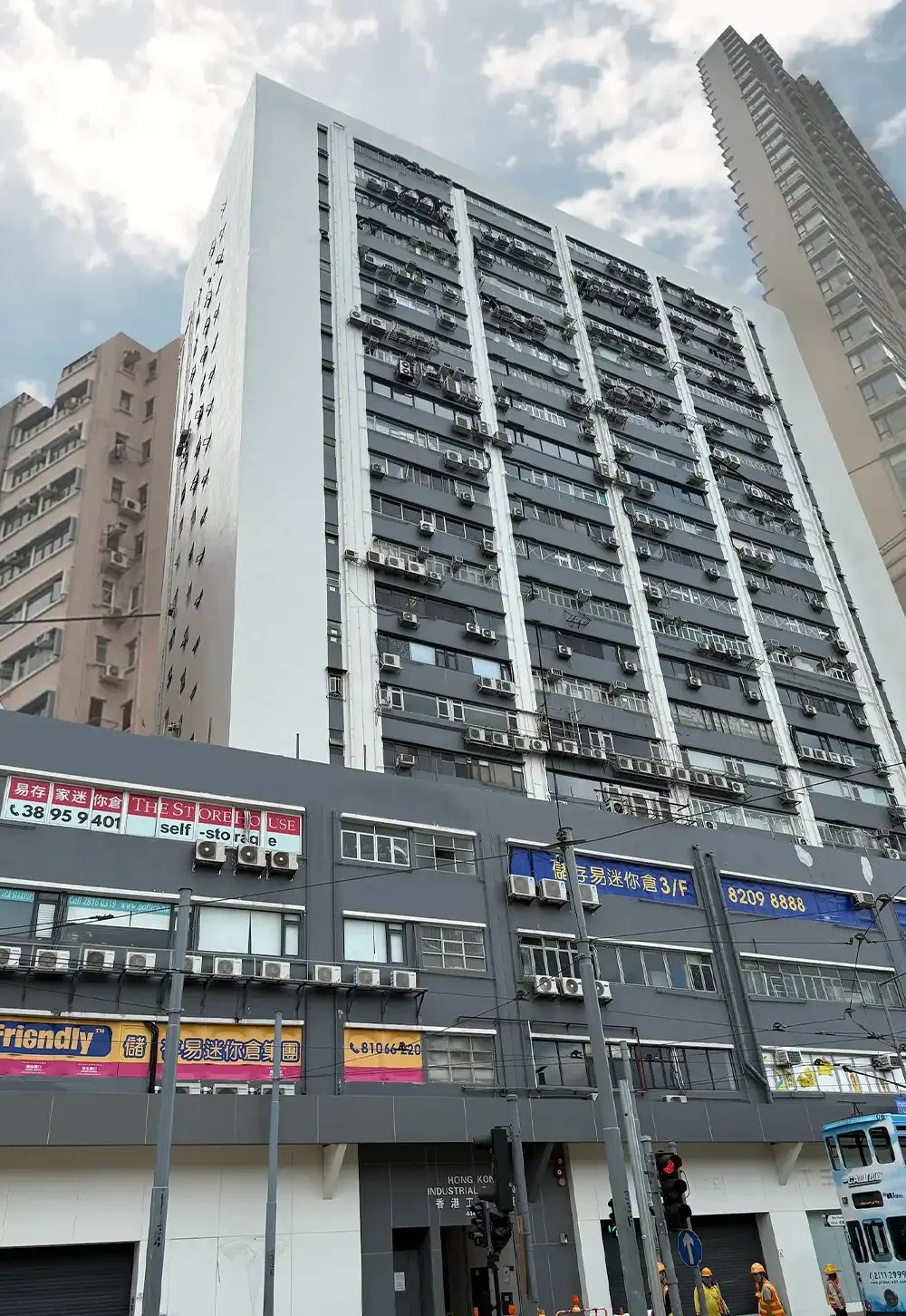
Exterior of The Store House building
Hong Kong facilities are often located near residential areas or transit stations for convenience, but the market looks nothing like the West. “A single building can house eight to 10 competing operators on different floors,” Ng says. “Our headquarters has 12 storage operators alongside retail and restaurants. It’s the only building in the world like this.”
Competition is intense since prices and promotions can be matched instantly. To stand out, The Store House focuses on service. Whereas many competitors operate remotely, The Store House always has two employees on site daily—and typhoons test that approach. “Last year, Hong Kong was hit with three in one week and it caused some water leakage,” says Ng. “Within 24 hours, we were calling customers and helping them sort things out. Operators without staff probably didn’t even know about the damage.”
Ng has also distinguished the company through social responsibility and was recently recognized by the Hong Kong Council of Social Service. Leona Lo, head of marketing and CX, led numerous initiatives, including its partnership with Hong Kong Dog Rescue.
New Chapters
As self-storage continued its growth spurt, large operators began franchising to expand quickly. But the model cracked after a devastating 2016 industrial building fire in the Ngau Tau Kok district claimed two firefighters. “It changed everything,” says Ng. Fire and construction rules tightened, requiring wider corridors, new door designs, clear escape routes, and more. Franchisees balked at the cost of bringing brownfield space up to compliance. SC Storage shrank from 120 sites to roughly 30 to 40 because many franchisees wouldn’t invest. The impact of the regulations continues, resulting in joint ventures, like the one Blackstone formed with StoreFriendly in 2019, buying entire buildings and converting them into Storefriendly Towers that the brand operates.
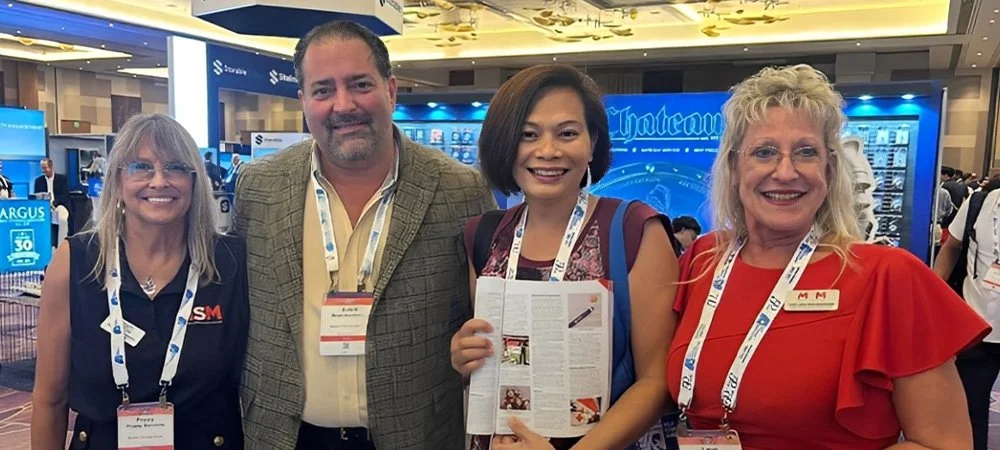
Poppy Behrens, Brad Hadfield, Leona Lo, and Lauri Longstrom-Henderson
“I expect more op-co/prop-co structures going forward. With financial backing from a major investor, brownfield repurposing makes sense,” Ng says. “It creates strong value-add and cap-rate uplift, which major funds gravitate toward.” The only hesitation, she says, is geopolitical. Some investors see Hong Kong as an extension of Mainland China. “Some may back away because of that perceived risk.”
Despite challenges, the market remains ripe for growth. It’s nearly four million square feet and projected to reach 5.82 million by 2030. “I’m surprised there are no Americans operating there yet,” says Good, who is enjoying semi-retirement. “Perhaps they’re waiting to swoop in and snatch what someone else has built. Helen’s properties, maybe?”
“We have been approached,” says Ng. “But our shareholders are Japanese, and they think long term.” As proof of that, The Store House just increased its footprint 50 percent, going from four facilities to six. “You can let Hardy know we’re not on the market,” she says with a smile.