
The Operator's Guide to Building a Connected Self Storage Technology Stack (And why you have to do it now!)

Michael Dogger
CEO, R6 Digital
Many self storage operators have built their technology stack piece by piece. Over time, they look at adding a booking system here, access control there, a tenant app to tie it together. And don’t forget the reporting tools and spreadsheets to fill the gaps.
Yet despite investing in multiple platforms, many still struggle to get a clear, reliable picture of how their storage business is actually performing. As the industry has matured, simply “having software” is no longer enough. The real question you should ask yourself or your team is whether your systems work together to provide clarity, efficiency, and control.
Increasingly, operators are discovering that a connected technology stack isn’t a luxury reserved for large enterprises. It’s an operational necessity for anyone looking to scale, compete, and make confident decisions not just in the Asian market, but globally.
For many operators, implementing a facility management system (FMS) feels like the moment their technology challenges are solved. And while an FMS is essential (it provides the operational backbone for managing units, tenants, and billing), it is only the foundation. The day-to-day requirements of running a modern self storage facility extend far beyond any single system.
Today, we can see that reservations are increasingly happening online, often outside business hours. Access control systems now need to manage who can enter when without staff involvement. Tenant communication flows through email, SMS, and mobile messaging apps. Reporting tools are needed to turn operational data into meaningful business insights. Marketing platforms attract and convert new customers. Each of these represents a distinct workflow, generating its own data and serving its own purpose.
The challenge isn’t just having these tools; it’s ensuring they work together. Without connection and coordination between systems, operators are left manually bridging the gaps, limiting visibility and introducing inefficiencies that become more pronounced as operations grow.
A modern self storage operation spans six distinct layers, each generating its own data and serving its own function. The graphic below maps them out. The question isn't whether your business uses all six layers; most operators do in some form. The question is whether they're working as a connected whole or operating in isolation.
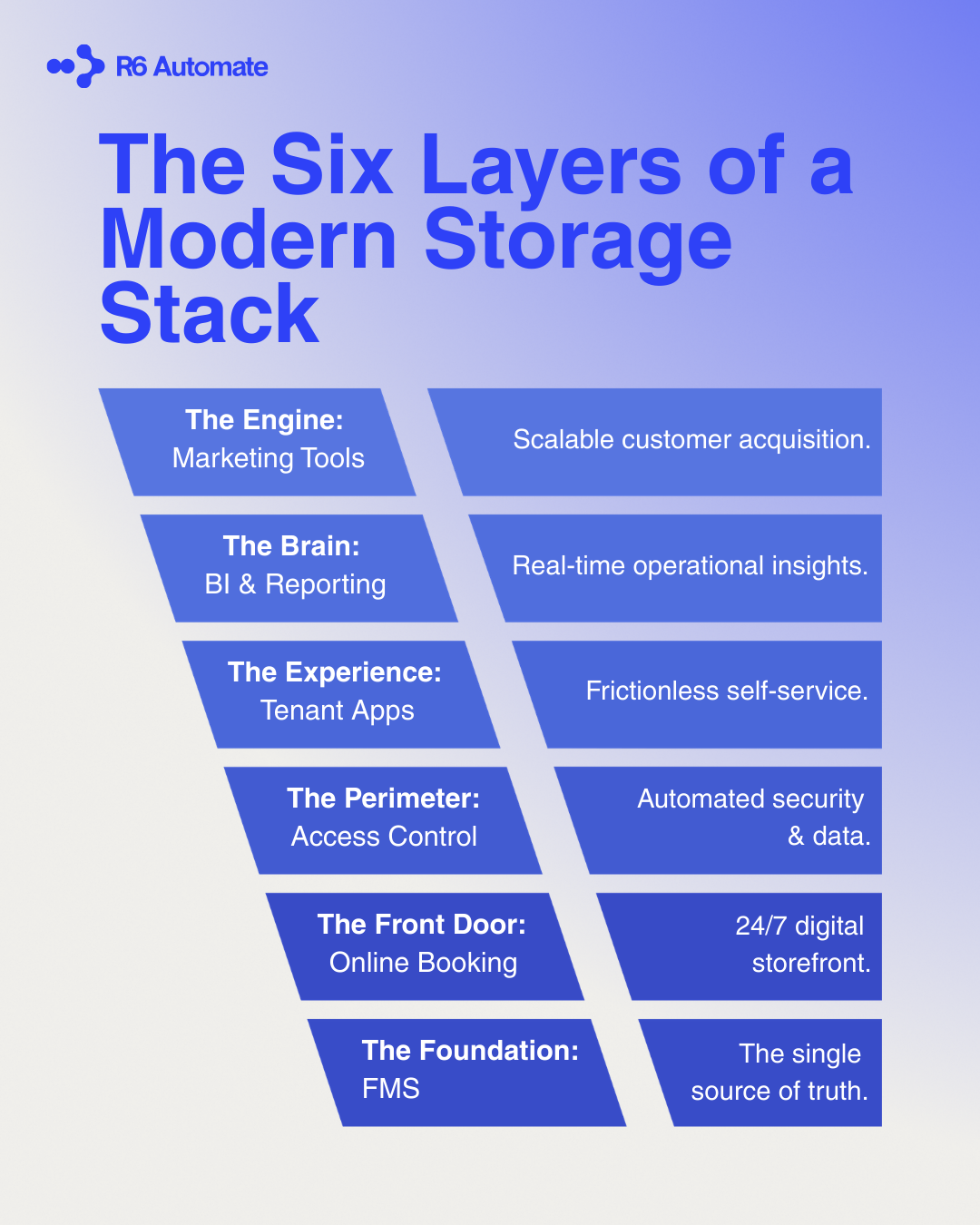
The consequences of a fragmented technology stack, more often than not, show up as small frictions that quietly drain time, erode confidence, and chip away at the tenant experience.
Consider a prospective tenant who completes an online booking outside business hours. In a disconnected environment, that booking may sit in one system while the access control platform remains unaware of it. Staff arrive the next morning to find a new reservation with no corresponding access code generated. A manual process kicks in, introducing delay and the possibility of error at the very first moment of the tenant relationship.
In another scenario, a tenant submits a maintenance request through a tenant app. Without integration, that request doesn't automatically create a task in the management platform. It sits, unactioned, until a staff member manually checks the backend. The tenant, having heard nothing, could choose to submit the request again or, in the worst case scenario, not renew their lease.
When systems don’t communicate, the impact goes far beyond operational inconvenience. Staff are forced to spend valuable time on manual workarounds such as re-entering information, reconciling reports, or switching between platforms to complete routine tasks. These inefficiencies accumulate quickly, reducing productivity and increasing the likelihood of human error. Data inconsistency presents an even greater risk. When information lives in multiple disconnected systems, operators may be making decisions based on incomplete or outdated data. This can affect everything from occupancy reporting to revenue forecasting, making it harder to respond confidently to changing conditions.
As facilities grow, these challenges scale with them. What may be manageable at one location becomes significantly more complex across multiple sites. As outlined in the 2025 SSAA Asia-Pacific Self Storage Annual Report, “over 90% of operators now employ at least one form of smart access or automation tool”. Without connected systems and automated workflows, expansion introduces operational strain instead of operational leverage, making it harder for operators to scale efficiently and sustainably.
In a connected technology stack, information flows automatically between systems, eliminating the need for manual intervention and ensuring that every layer of the operation stays aligned. Each system performs its role, but none operate in isolation.
From the tenant’s perspective, this creates a seamless journey. From initial enquiry to move-in, ongoing account management, and eventual move-out. For operators and managers, it provides something equally valuable: a single, reliable source of truth. Reporting becomes clearer, decisions can be made with confidence, and operational blind spots are reduced.
This is the essence of the R6 Automate ecosystem. Integration isn’t treated as an afterthought or a workaround, but as a core design principle. Each layer is designed to work as part of a coordinated whole, allowing operators to scale their business without disrupting the workflows they depend on.
Technology decisions are rarely isolated. When you are choosing your technology stack, it’s worth pausing to evaluate how it will fit into the bigger picture. Some platforms will offer a new feature that may solve an immediate problem, but if it introduces complexity elsewhere, the long-term cost can outweigh the short-term gain.
As customer expectations continue to rise and competition intensifies, operational clarity will become an even stronger differentiator. Operators who invest in connected systems today are not simply upgrading their tools, they are strengthening the foundations of their business. Those foundations will determine how confidently they can adapt, compete, and scale in the years ahead.
A useful starting point for any operator is simply mapping their current tools against the six layers and asking where the connections break down. Those gaps are usually where the friction lives, and where an opportunity to improve intelligence and efficiency exists.
For operators looking to explore what a connected stack could look like for their business, R6 Automate works with facilities across the APAC region and beyond to help identify integration gaps and build technology ecosystems designed for long-term growth. You can find more information at r6automate.com or contact the author directly at enquiry@r6automate.com.